
Sustainability
Initiatives for Biodiversity Conservation
Basic Approach
Biodiversity is being rapidly lost due to global warming, environmental pollution, unsustainable development, overexploitation, and other human activities, and ecosystems are under severe pressure. If action is not taken now, society as a whole may suffer major damage in the future because people may no longer be able to benefit from ecosystem services, making it impossible to realize the sustainable society envisioned by the SDGs. The Mitsuboshi Belting Group has worked to reduce CO₂ emissions in order to mitigate global warming. The Group also recognizes biodiversity loss as a risk of equally high importance and urgency for society as a whole.
The Group supports the Kunming-Montreal Global Biodiversity Framework adopted at the 15th Conference of the Parties to the Convention on Biological Diversity (COP15) and the Japanese government’s National Biodiversity Strategy 2023-2030. The Group has identified biodiversity conservation as a material issue and will implement initiatives related to climate change, water resource conservation, prevention of deforestation, environmental conservation, and prevention of environmental pollution, based on specific measures and KPIs.
Governance and Risk Management
The governance and risk management processes for the Group’s biodiversity conservation activities are the same as those described on the “Initiatives Related to Climate Change” page.
Strategy
At the Sustainability Committee, the Group investigated and examined the dependencies and impacts of its business activities on natural capital and verified them using ENCORE*1, an online tool provided by the United Nations and other organizations. In accordance with the LEAP approach, the disclosure framework recommended by the TNFD, the Group identified risks and opportunities related to biodiversity conservation, assessed their impacts on the Group’s business activities, and incorporated the results into its strategy and targets.
The Group identified several issues to be addressed. Its production activities depend on water, and insufficient freshwater supply from nature poses a business risk. Expansion of natural rubber plantations can contribute to deforestation. Cotton cultivation in regions with limited water resources can also exacerbate the water supply-demand balance through water withdrawal and pesticide pollution. Climate change caused by CO2 emissions from the Group’s business activities affects biodiversity in various ways. Because these impacts are global in scale, the Group discloses its climate-related activities in accordance with the framework recommended by the TCFD. Please refer to “Initiatives Related to Climate Change.
*1 ENCORE (Exploring Natural Capital Opportunities, Risks and Exposure) is an online tool jointly developed by the Natural Capital Finance Alliance, the United Nations Environment Programme World Conservation Monitoring Centre (UNEP-WCMC), and other organizations. It enables organizations to investigate their exposure to nature-related risks and to identify and assess their dependencies on and impacts on nature.
Relationship between Business Activities and Nature
1. Dependencies on and Impacts on Nature
At the Group’s production sites, steam is used as a heat medium and water as a coolant in the processing of rubber products. Without a sufficient supply of high-quality fresh water from nature, operations would have to be suspended immediately. Natural rubber, cotton, and oils derived from palm oil are used as non-petroleum-based raw materials in rubber products. If supplies of these materials were disrupted, the Group would have to rely on petroleum-based raw materials, increasing the risk of resource depletion. The Group’s main products, power transmission belts and related products, are widely used in agriculture, forestry and fisheries, mining, semiconductors, automobiles, electrical equipment, machinery, food, logistics, and many other industries. These industries depend on ecosystem services in different ways.
Because the Group’s products support these industrial activities, the Group recognizes that its business activities also depend directly and indirectly on a wide range of ecosystem services.
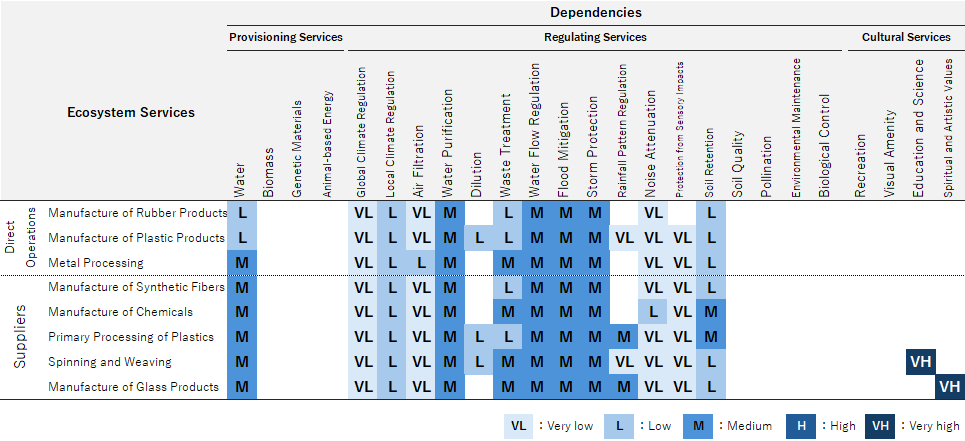
Using ENCORE, the Group assessed the dependencies of its business activities on ecosystem services, covering ISIC manufacturing, manufacture of rubber and plastic products, and manufacture of rubber products. No dependencies were rated High or above. Four ecosystem services, water purification, water flow regulation, flood mitigation, and storm mitigation, were rated Medium. Similar assessments were conducted for the Group’s other activities, including plastic product manufacturing and metal processing, and for business partners’ activities, including synthetic fiber manufacturing, chemical manufacturing, primary plastics processing, spinning and weaving, and glass product manufacturing, as shown in the table below.
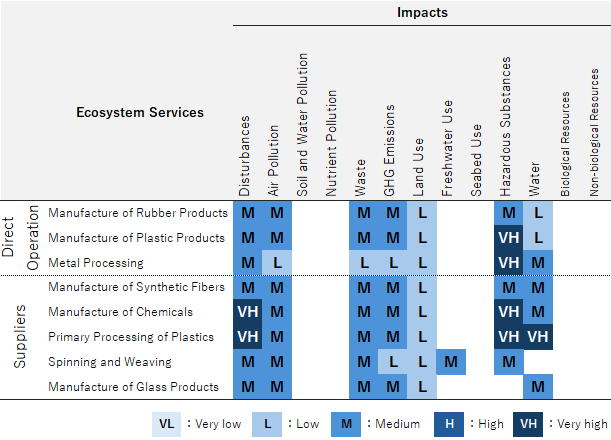
The Group also assessed the impacts of its business activities on ecosystem services. Its production activities consume water, natural resources, energy, and other resources and generate waste, wastewater, exhaust emissions, waste heat, noise, and odors that affect the natural environment. ENCORE identified no impacts rated High or above for the manufacture of rubber products. Four impact drivers, disturbance, CO2 emissions, air pollution, and solid waste, were rated Medium. The results for other Group activities and business partners’ activities are shown in the table below.
Based on these results, the Group will continue to promote specific initiatives in production and product design that support the sustainable use of natural capital, efficient resource use, and mitigation of environmental impacts.
2. Points of Contact between Business Activity Regions and Regions Important for Biodiversity
The Group investigated and identified points of contact between regions associated with its business activities across the product life cycle and regions important for biodiversity. The business activity regions examined were the locations of the Group’s 14 production sites, the production regions for natural rubber and cotton, and crude oil production regions as sources of raw materials and energy.
The regions important for biodiversity included hotspots*2 where ecosystem integrity is being lost, AZE sites*3 where endangered species require protection, and regions with high water stress*4. The results are shown in the table below.
| Country / area | Hotspot | AZE site | Water stress | ||
|---|---|---|---|---|---|
| Production site | Kobe Plant R&D center | Japan | ● | ||
| Shikoku Plant | Japan | ● | |||
| Nagoya Plant | Japan | ● | |||
| Ayabe Production System Development Center | Japan | ● | |||
| Shiga Plant | Japan | ● | |||
| Mitsuboshi Cord Co., Ltd. | Japan | ● | |||
| Seishin Plant | Japan | ● | |||
| MBL (USA) CORPORATION | U.S.A. | ● | |||
| PT. MITSUBOSHI BELTING INDONESIA | Indonesia | ● | |||
| PT. SEIWA INDONESIA | Indonesia | ● | |||
| STARS TECHNOLOGIES INDUSTRIAL LIMITED | Thailand | ● | |||
| Suzhou Mitsuboshi Belting Co., Ltd. | China | ● | |||
| MITSUBOSHI POLAND Sp.z o.o. | Poland | ||||
| MITSUBOSHI BELTING-INDIA PRIVATE LIMITED | India | ● | |||
| Locations of natural rubber production | Thailand, Indonesia, Vietnam | ● | ● | ||
| Locations of cotton production | India, Pakistan | ● | |||
| Locations of oil and natural gas production | Middle East | ||||
Ten production sites are located in biodiversity hotspots, three production sites are located in regions with high water stress, natural rubber production regions overlap with hotspots and AZE sites, and cotton production regions are located in regions with high water stress.
As described above, the Group recognizes that water consumption, wastewater, exhaust emissions, and water pollution caused by waste from operations at each site affect ecosystems. The Group will establish site-specific issues and targets and promote biodiversity conservation initiatives at the ten production sites located in hotspots and the three production sites located in regions with high water stress. The Group also recognizes the impacts of business partners’ activities on ecosystems, including deforestation associated with land use for natural rubber production, water consumption for cotton cultivation, and pesticide-related pollution. In cooperation with suppliers, the Group will promote the procurement of raw materials that does not contribute to biodiversity loss.
*2 A biodiversity hotspot is a region that supports at least 1,500 endemic vascular plant species, including seed plants and ferns, but where more than 70% of the original ecosystem has been altered.
*3 An AZE site is a location identified by the Alliance for Zero Extinction as the last remaining habitat of one or more of 1,483 of the world’s most endangered species.
*4 Regions with high water stress are defined as regions classified as “Extremely High” for Water Stress in the World Resources Institute’s Aqueduct Water Risk Atlas.
Scenario Analysis and Risks and Opportunities
Taking into account the relationship between the Group’s business activity regions and regions important for biodiversity, as well as the scenarios shown in Table 1, the Group summarized the identified risks and opportunities and corresponding response measures in Table 2. The scenarios were developed based on publicly available biodiversity reports and information from the World Resources Institute’s Aqueduct and describe possible conditions for nature and society in 2030 and 2050.
Table 1: Near-Term Scenarios Based on the Status of Biodiversity Conservation
| Scenario in which biodiversity is conserved | Scenario in which biodiversity is lost | |
|---|---|---|
| 2030 | Environmental degradation stops and ecosystems begin to recover. | Regions important for biodiversity expand compared with the present. |
| Disasters associated with deforestation and climate change decrease compared with the present. | Environmental degradation amplifies the scale of climate-related disasters. | |
| Strict environmental assessments are applied to land development in all industries. | Land development expands under environmental assessments that remain as ambiguous as at present. | |
| Recovery of biodiversity eases water stress that is worsening due to population growth and other social factors. | Biodiversity loss further exacerbates water stress. | |
| Environmental Contribution Products become mainstream in the market. | Environmental Contribution Products are driven out of the market by price competition. | |
| Ecosystem services are provided reliably, supporting stability for people, companies, regions, and society. | Ecosystem services become unstable, increasing shortages, price rises, and regional conflicts. | |
| 2050 | Ecosystem recovery progresses and biodiversity becomes richer than at present. | Regions important for biodiversity expand further compared with 2030. |
| Disasters associated with deforestation and climate change decrease compared with 2030. | Climate-related disasters intensify further compared with 2030. | |
| Even stricter environmental assessments are applied to all land development. | Strict environmental assessments finally become standard for land development in all industries. | |
| While biodiversity recovers, water stress worsens due to population growth and other social factors. | Biodiversity loss further accelerates the worsening of water stress. | |
| Products that do not address environmental considerations are eliminated from the market. | Higher-priced Environmental Contribution Products finally become mainstream in the market. | |
| Ecosystem services are provided reliably, supporting stability for people, companies, regions, and society. | The provision of ecosystem services is severely disrupted, and shortages, price rises, and regional conflicts increase further compared with 2030. |
Table 2: Risks and Opportunities Related to Biodiversity Conservation
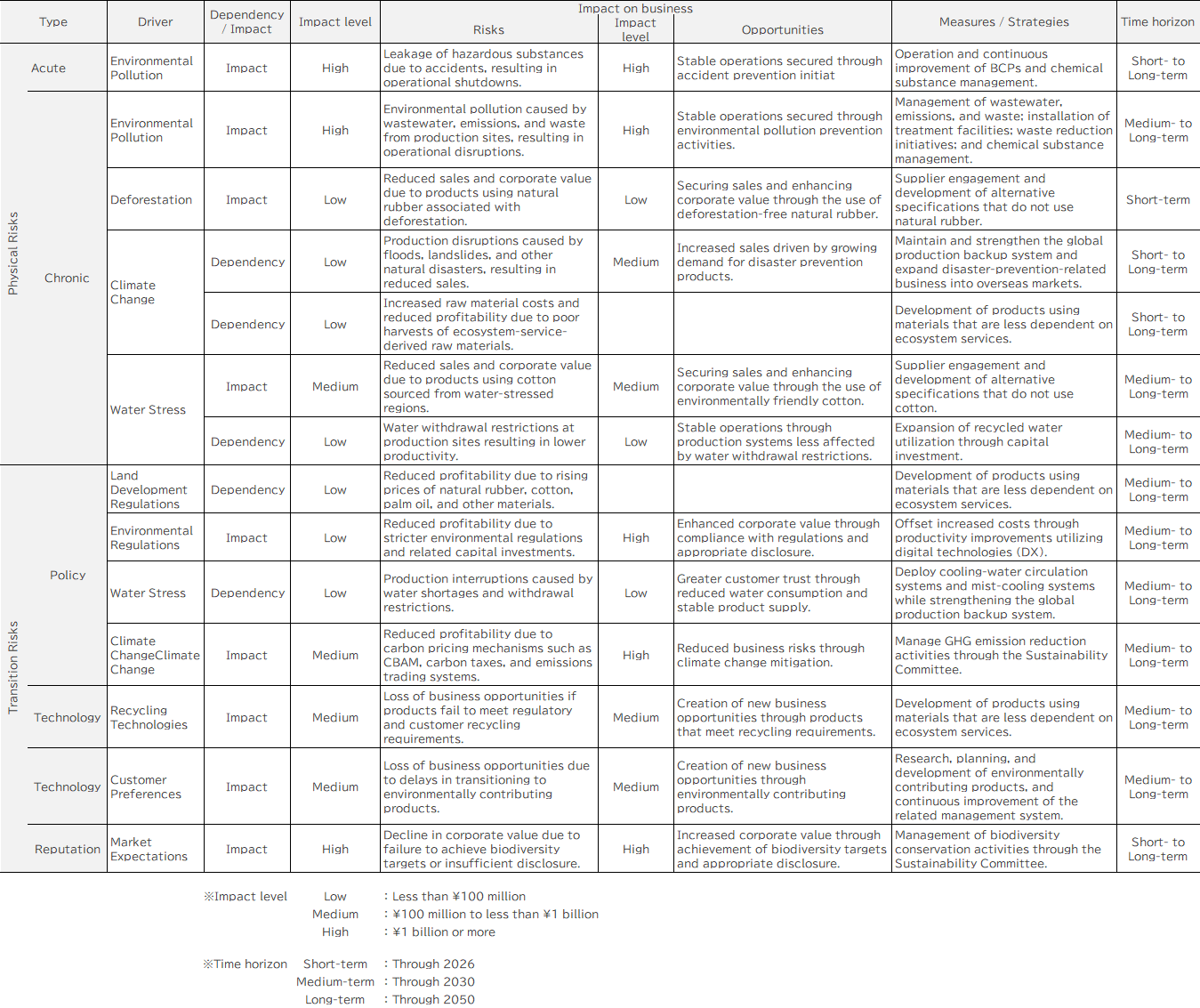
Failure to develop Environmental Contribution Products that support biodiversity conservation could result in financial impacts through the loss of new business opportunities and reduced demand for existing products. Just as products with large carbon footprints may be excluded from markets as climate action advances, products that adversely affect biodiversity may also be excluded. The EU Deforestation Regulation (EUDR)*5 entered into force in June 2023 and requires companies exporting to the European market to ensure that covered products are not linked to deforestation. The Group will work with suppliers to collect information on deforestation in natural rubber production areas and will contribute indirectly to preventing deforestation by avoiding the procurement of natural rubber linked to deforestation.
Water-related infrastructure business in regions with high water stress is expected to expand. The Company’s water-shielding sheets and installation services are already widely used in water-related projects in Japan, but have seen limited deployment in overseas regions with high water stress. The Company will use the sales network for its core power transmission belt products to expand its water-shielding sheet and installation service business in such regions.
Reducing water withdrawal and appropriately disclosing progress are important business measures, as are the reduction, calculation, and disclosure of CO₂ emissions in addressing climate change. For the Group’s water-dependent production activities, transitioning to production that consumes as little water as possible is an urgent priority. The Company’s experience has confirmed that using recycled water through cooling-water circulation systems is effective in reducing water consumption. The Group will actively deploy these systems to steadily reduce water withdrawal. It will also ensure appropriate wastewater treatment and water-quality management at production sites to prevent pollution of local environments.
*5 The EUDR is intended to minimize the EU’s contribution to global deforestation and forest degradation. It covers seven commodities traded in the EU market, cocoa, coffee, palm oil, rubber, soy, cattle, and wood, as well as derived products. It prohibits the marketing of products linked to deforestation and requires due diligence. Under the schedule stated in the source document, products that do not meet EUDR requirements may not be sold in the EU from December 30, 2026 for large companies and from June 30, 2027 for SMEs and other companies.
Targets and Implementation Status
Water Resource Conservation Activities
The Group works to reduce water withdrawal and prevent water pollution. Please refer to “Initiatives Related to Water Resource Conservation” for details.
Deforestation Prevention Activities
The Group has completed the development of product specifications that do not use natural rubber. However, these products inevitably use non-renewable materials. In view of resource depletion, natural rubber will therefore continue to play an important role as a raw material. At the same time, as noted above, natural rubber is a material associated with biodiversity risks.
The Group regards the establishment of supply chains for major raw materials, including natural rubber, that are not linked to deforestation or conversion of natural ecosystems as an important corporate responsibility. To meet the EUDR requirements for deforestation-free products and legality, the Group is developing transparent traceability and due diligence systems and will continue to promote procurement practices that contribute to ecosystem conservation in cooperation with business partners.
- Promotion System
The Procurement Department leads the establishment of procurement, production, logistics, and sales systems aligned with the EUDR. Progress is reported to management at the Sustainability Committee. The Sustainability Committeeg monitors and evaluates implementation and reports to the President and the Board of Directors. - □ Targets and Implementation Status
Because the EUDR application date had been set for December 30, 2025, the Group worked toward switching 100% of the natural rubber used in products for the EU to natural rubber not linked to deforestation by September 2025. Although the application date was postponed to December 30, 2026, 100% of the natural rubber used by the Group in products for the EU has already been switched to natural rubber not linked to deforestation. The Group plans to maintain and improve this supply system in FY2026.
CO2 emissions Reduction Activities
Climate change is one of the major drivers of biodiversity loss. Please refer to “Initiatives Related to Climate Change” for the targets and implementation status of CO2 emissions reduction activities.
Air Pollution Prevention Activities
In the Group’s production activities, high-pressure steam generated by boilers is used as a heat source in the vulcanization of rubber products. Burning heavy oil, natural gas, and other fuels to generate steam creates a risk of air pollution from exhaust emissions. Adhesive treatment processes also use air heated by burning these fuels, creating a similar risk. In addition, organic solvents in adhesives may volatilize as volatile organic compounds (VOCs), creating another air pollution risk.
Five production sites in Japan have either vulcanization or adhesive treatment processes. The Group monitors air pollutants regulated under Japan’s Air Pollution Control Act, including NOx, SOx, soot and dust, and VOCs. The Group has set a target of limiting VOC emissions to 73 t or less per year.
- □ VOC Reduction Activities
Three Group production sites have adhesive treatment processes that generate large volumes of VOCs. Combustion-type VOC treatment systems have been installed at all three sites, reducing VOC emissions from these processes to almost zero. Heat generated by the treatment systems is reused in the adhesive treatment processes, helping reduce fuel consumption. In FY2025, VOC emissions in Japan increased 4.2% year on year to 43 t, equivalent to 4.4% of total VOC use. - □ NOx, SOx, and Soot and Dust Monitoring Activities
In FY2025, no measurements exceeded the standards under Japan’s Air Pollution Control Act. At two production sites in Japan, fuel was switched from Class A heavy oil to natural gas (LNG) as a measure to reduce CO2 emissions. As an additional benefit, concentrations of SOx and soot and dust in regulated exhaust gases have been reduced to almost zero.
Chemical Substance Management and Green Procurement
To reduce environmental and occupational health and safety risks, the Group manages chemical substances in compliance with applicable laws and regulations and implements green procurement. For details, please refer to “Value Chain Management: Occupational Safety and Health.
Collaboration with External Organizations
The Group supports the aims of the Taskforce on Nature-related Financial Disclosures (TNFD*6). It joined the TNFD Forum in October 2023 and has participated as a member. The Group disclosed its biodiversity conservation activities in Sustainability Report 2023 in accordance with the TNFD-recommended disclosure framework. In August 2025, the Group registered as a TNFD Adopter*7 and will further accelerate its efforts toward a nature-positive society that seeks coexistence with nature.

*6 The Taskforce on Nature-related Financial Disclosures is an international initiative that aims to develop a framework enabling companies and financial institutions to appropriately assess and disclose risks and opportunities related to natural capital and biodiversity.
*7 A TNFD Adopter is a company that has registered on the TNFD Forum website its intention to disclose information in line with the TNFD framework.