
Sustainability
Initiatives Related to Corporate Governance
This page outlines the Company’s corporate governance initiatives.
The Company works to establish a sound governance structure that ensures highly transparent management and earns the trust of stakeholders.
* Information is current as of January 1, 2026.
Structure Diagram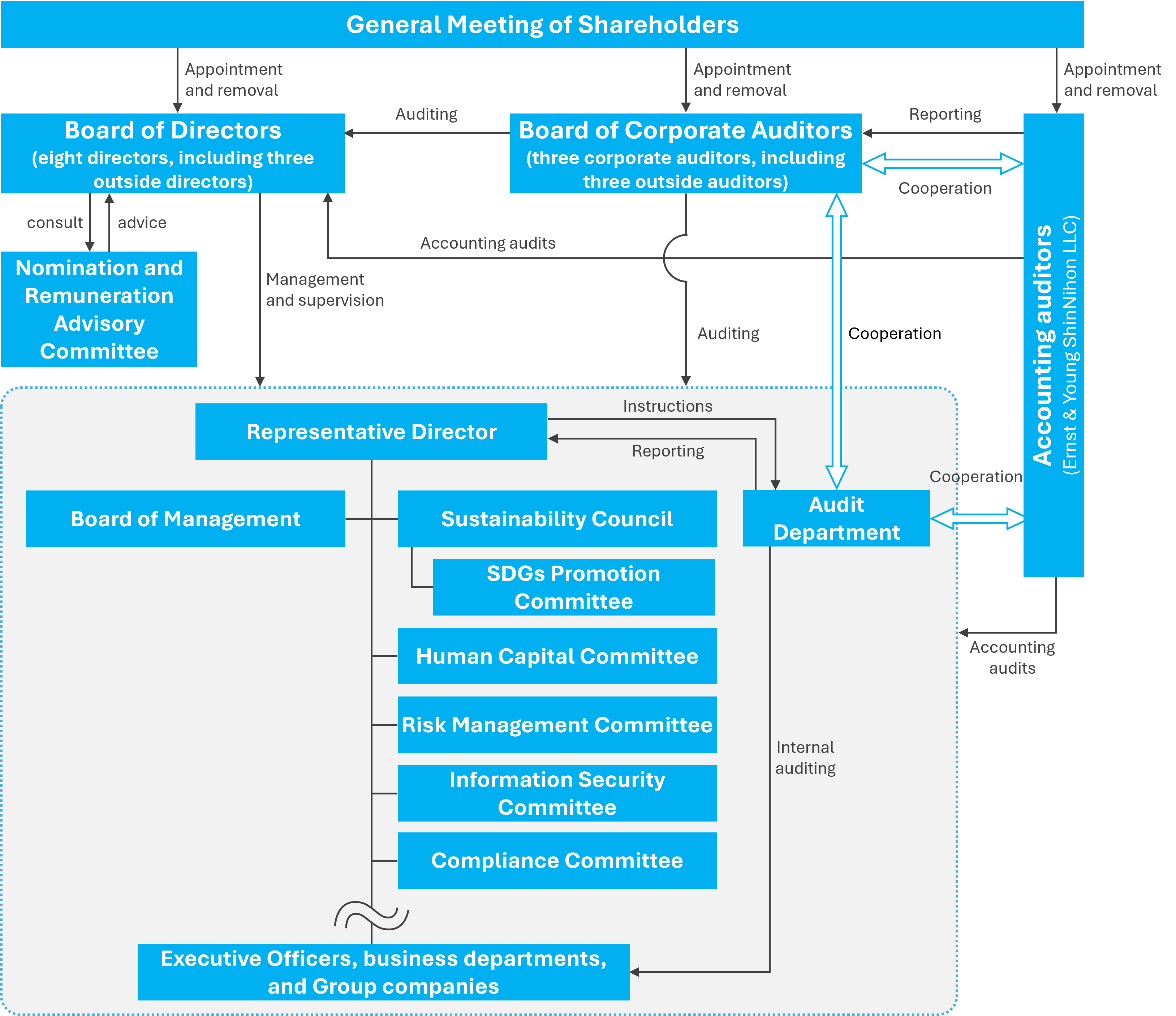
Major Initiatives to Strengthen Corporate Governance
| Date | Major initiatives |
| October 2003 | Introduced an executive officer system |
|---|---|
| May 2015 | Established the Risk Management Committee and Compliance Committee |
| Established the Basic Corporate Governance Policy | |
| June 2015 | Appointed two outside directors |
| April 2016 | Launched a questionnaire-based evaluation of the effectiveness of the Board of Directors |
| October 2018 | Established the CSR Promotion Committee*1 |
| March 2021 | Established the Personnel and Remuneration Advisory Committee (three of five members are independent outside directors) |
| June 2021 | Introduced a restricted stock compensation plan |
| April 2022 | Established the Sustainability Promotion Committee |
| June 2022 | Appointed one woman as an outside director Shifted to a structure with three outside directors |
| June 2022 | Established a Board of Directors structure in which outside directors account for at least one-third of the Board |
| June 2022 | Shortened the term of office of directors from two years to one year |
| July 2024 | Established the Sustainability Council |
| July 2024 | Introduced a performance-linked remuneration system*2, effective from remuneration paid in July 2024 |
| January 2026 | Established the Human Capital Strategy Committee |
*1 Renamed the SDGs Promotion Committee in March 2021.
*2 “Remuneration, etc. for Directors” consists of the basic salary, position-based salary, and performance-linked portion* as basic remuneration (monetary remuneration), and restricted shares as basic remuneration (stock remuneration). “Remuneration, etc. for Outside Directors,” in light of their responsibilities and duties, consists only of basic salary as basic remuneration (monetary remuneration).
Effective from remuneration paid in July 2024, the performance-linked portion was revised to use net sales, operating profit, and return on equity as performance indicators.
With respect to the ratio by type of remuneration after the change, when performance indicators are achieved 100%, the approximate ratio is designed to be: fixed portion of basic remuneration (monetary remuneration) : performance-linked portion of basic remuneration (monetary remuneration) : basic remuneration (stock remuneration) = 60 : 20 : 20. However, because the performance-linked portion actually paid varies depending on the Company’s business performance, the payment ratio varies.
Strengthening Corporate Governance
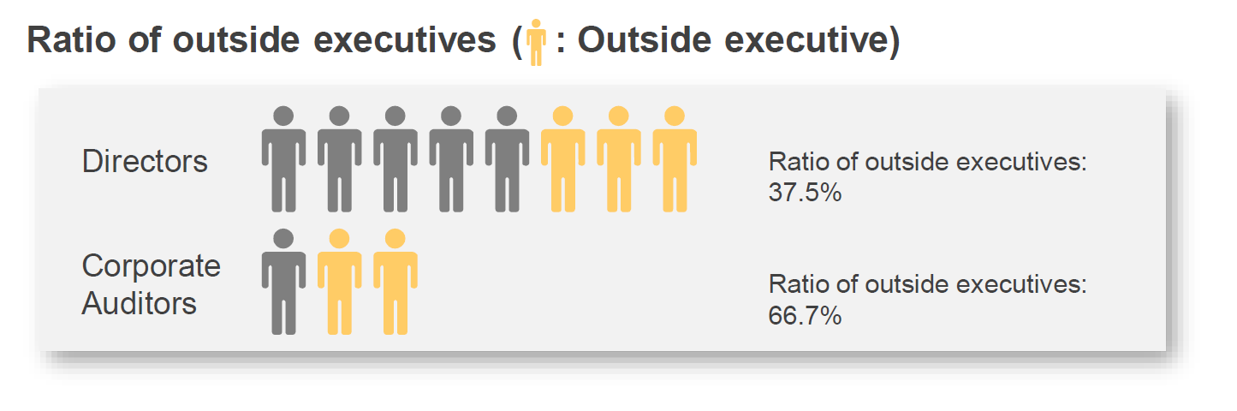
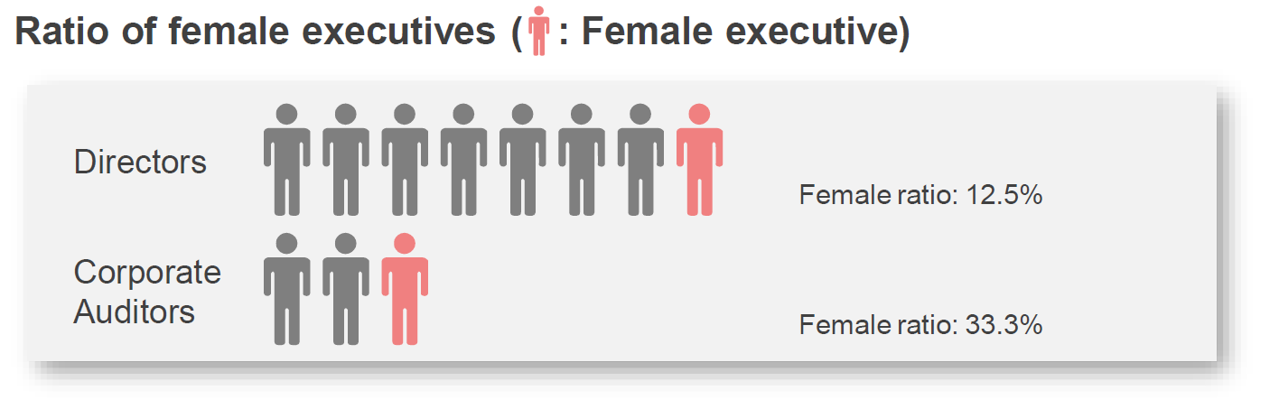
The Company is a company with an Audit & Supervisory Board. The Board of Directors consists of eight directors, including three outside directors, and the Audit & Supervisory Board consists of three members, including two outside members. The Board of Directors makes decisions on important matters and supervises directors’ execution of duties. Important matters are discussed in advance by the Management Council before being submitted to the Board of Directors.
The Company has also established the Personnel and Remuneration Advisory Committee, a voluntary advisory body comprising three or more members, the majority of whom are independent outside directors. The Committee strengthens the independence, objectivity, and accountability of the Board of Directors in matters concerning the appointment, dismissal, and remuneration of management. The Company is further enhancing corporate governance through measures such as a restricted stock compensation plan designed to align interests with shareholders and support long-term corporate value. The ratios of outside officers and women among directors and Audit & Supervisory Board members are shown in the figures.
Approach to Director Nomination
When selecting senior management and nominating director candidates, the Company comprehensively considers whether candidates possess the diverse experience, knowledge, and capabilities, as well as the broad perspective, ability to act, and leadership required to further enhance the Group’s corporate value.
Skill Matrix of Each Director (List of Knowledge, Experience, Abilities, etc.)
| Position | Name | Management / Business Planning |
HR / General Affairs / Legal |
Digital (DX Promotion) |
Finance / Accounting |
ESG / Sustainability |
Technology / Innovation / Procurement / Production |
Sales / Marketing | Global Experience |
|
Representative Director and President |
Hiroshi Ikeda |
○ |
○ |
|
|
○ |
|
○ |
○ |
|---|---|---|---|---|---|---|---|---|---|
|
Director |
Toshimi Kumazaki |
○ |
|
|
○ |
|
○ |
○ |
○ |
|
Director |
Keiji Mataba |
○ |
○ |
|
|
|
|
○ |
○ |
|
Director |
Shinji Kuramoto |
○ |
○ |
|
○ |
○ |
○ |
|
|
|
Director |
Kazuhiro Takeda |
|
|
○ |
|
|
○ |
|
○ |
|
Director |
Shinya Okuda |
○ |
|
|
|
○ |
|
○ |
○ |
|
Director |
Yuka Miyake |
|
|
|
○ |
○ |
|
|
|
|
Director |
Yasuhiro Tsuji |
|
○ |
|
|
○ |
|
|
|
Main Skills (Knowledge, Experience, Abilities, etc.) Required for the Board of Directors as a Whole, and Reasons for Selection
| Skill | Reason for selection |
| Management / Business Planning | Because it is necessary to promote the creation of a company that contributes to the realization of a sustainable society through business activities, look ahead to the future vision, and formulate and supervise growth strategies that contribute to sustainable value creation from a medium- to long-term perspective. |
|---|---|
| HR / General Affairs / Legal | Because it is necessary to work on “strengthening Human Capital Strategy,” which is the highest-priority issue in the '24 Mid-Term Business Plan, develop human resources who promote transformation, and build a strong corporate governance structure, including compliance and risk management. |
|
Digital |
Because improving productivity through the introduction of AI, improving the efficiency of indirect department operations using digital technologies, and speeding up new product development and reducing man-hours are necessary to maintain and strengthen competitiveness. |
| Finance / Accounting | Because it is necessary to formulate financial and capital strategies conscious of the cost of capital and to promote capital policies that improve medium- to long-term corporate value by appropriately executing growth investments and shareholder returns to enhance shareholder value. |
| ESG / Sustainability | Because, under the corporate philosophy “To give attentive consideration to both humanity and nature,” it is necessary to formulate and execute strategies from both the risk and opportunity perspectives concerning the future impact of environmental and social changes, including climate change, on the business in order to contribute to the realization of a sustainable society. |
| Technology / Innovation / Procurement / Production | Because, in order to embody the management basic policy “to contribute to society through the provision of highly functional, highly precise and high-quality products” and to continue maintaining and strengthening competitive advantage over the medium to long term, it is necessary to improve and develop intellectual and technological capital and manufacturing capital. |
| Sales / Marketing | Because, to realize a co-creation-oriented business model focused on customer value, effective sales and marketing activities are necessary to understand the characteristics of each industry, accurately grasp customer needs, and maximize brand value. |
| Global Experience | Because, for the Company whose overseas sales ratio exceeds 50%, it is necessary to formulate and execute business strategies from a global perspective with knowledge of the business environments and needs of different markets and with consideration for geopolitical risks and other risks. |
Roles Expected of Independent Outside Directors
- Possess high levels of expertise, extensive practical experience, and leadership experience in fields such as corporate management, international business, finance and accounting, financial services, compliance, the legal profession, public administration, academia and research, risk management, human resource development and education, and IT and digital technology.
- Be capable of taking a Group-wide perspective and identifying fundamental issues and risks, and be expected to contribute to candid, active, and constructive deliberations at meetings of the Board of Directors and other bodies.
- Be able to provide objective oversight and judgment of management, as well as advice and support for the Company’s sustainable growth, from a practical perspective grounded in extensive experience in corporate management and specialized fields.
- Meet the requirements for outside directors under the Companies Act and the independence criteria established by the Tokyo Stock Exchange.
Status of Operation of the Board of Directors
In accordance with laws and regulations, the Articles of Incorporation, and the Board of Directors Regulations, the Board of Directors deliberates and resolves matters concerning basic management policies, investments, and other important business execution, including the disposal and acquisition of significant assets, large borrowings, establishment or reorganization of important organizations, and appointment or dismissal of important employees. The Board also receives reports on directors’ execution of duties and other important business matters.
| Item | FY2025 |
| Number of meetings held | 14 |
| Average meeting duration | 87.1 minutes |
| Average number of agenda items | 5.9 |
In FY2025, in addition to regular resolution matters and reporting matters, the Board deliberated on matters related to the '24 Mid-Term Business Plan, important issues related to corporate governance (nomination and remuneration of directors, succession plans for the representative director and directors, etc.), and major investment projects (production and logistics-related, business-related investments). In addition, from the perspective of sustained improvement of corporate value, the Board also received reports and held discussions on priority issues in non-financial fields, including climate change and human capital.
To support effective Board operation and allow sufficient deliberation within the available meeting time, preliminary briefing sessions are held for outside directors before Board meetings. Thirteen preliminary briefing sessions were held in FY2025.
| Category | Major agenda items at Board of Directors meetings (excerpt) |
|
Management policy / Growth strategy |
|
| Other |
|
Status of Operation of the Personnel and Remuneration Advisory Committee
| Item | FY2025 |
| Number of meetings held | 9 |
| Average meeting duration | 31.7 minutes |
The Company has established the Personnel and Remuneration Advisory Committee as a voluntary advisory body to strengthen the independence, objectivity, and accountability of the Board of Directors in matters concerning the appointment, dismissal, and remuneration of management. The Committee comprises three or more members, the majority of whom are independent outside directors, and is chaired by an independent outside director.
In response to consultations from the Board of Directors and in accordance with its regulations, the Committee deliberates and decides on policies and procedures for nominating director candidates, selecting and dismissing senior management, succession planning for the Representative Director and directors under normal and emergency circumstances, and determining directors’ remuneration.
In FY2025, to build a framework supporting the Company’s future sustainable growth, the Committee interviewed 13 department general managers identified as candidates for next-generation leadership roles, for approximately 30 minutes each, and reviewed their capability development and career plans. Based on the interview results, the Committee deliberated on matters including assessments of their suitability as next-generation leaders and their development policies.
Evaluation of the Effectiveness of the Board of Directors
The Company evaluates the effectiveness of the Board of Directors annually to maintain and further improve its functioning. The evaluation method, process, and results are outlined below.
Evaluation Process
January 2026: The Board of Directors Secretariat reviewed and discussed the implementation method and determined the purpose and basic policy.
February 2026: Self-evaluation questionnaires were conducted by the target persons, and the Secretariat confirmed and analyzed the questionnaire results.
March 2026: Based on the aggregation and analysis results, an opinion exchange meeting was held by the Board of Directors, and issues for further improving effectiveness going forward were shared.
Evaluation Items (Section Names of the Self-evaluation Questionnaire)
Roles and responsibilities of the Board of Directors, and its composition and operation
Management strategy and business strategy
Corporate ethics and risk management
Evaluation and remuneration of management
Dialogue with shareholders and others
Evaluation Results and Future Issues
Based on these results, at the Board of Directors meeting held in March 2026, the Company evaluated that “the current Board of Directors is functioning effectively and fulfilling its responsibilities toward enhancing corporate value.” Based on this fiscal year’s opinion exchange meeting, the following matters were recognized and shared as issues for further improving effectiveness going forward.
- Deepening strategic discussions and expanding opportunities concerning medium- to long-term management strategies and growth and value-creation narratives
- Making consideration of Human Capital Strategy linked to management strategy more concrete and improving its effectiveness
- Expanding opportunities to consider the appropriate form of governance* based on the desired role and composition of the Board of Directors
- Strengthening the risk management system and risk response capabilities in light of changes in the business environment
* Institutional design and utilization of third-party organizations in effectiveness evaluation, etc. From FY2026 onward, the Company will continuously monitor and improve the status of responses to these issues based on the PDCA cycle, and will work to further improve the effectiveness of the Board of Directors.
Status of Dialogue with Shareholders and Investors
The Company has established a Policy on Constructive Dialogue with Shareholders and actively engages with shareholders to promote constructive dialogue. Shareholder views identified through these dialogues are reported as necessary to directors, management, and relevant internal departments, where the information is shared and used.<br? In FY2025, the Company held a total of 55 financial results briefings and individual dialogues with institutional investors and analysts and received valuable feedback. The Company will continue to deepen relationships of trust with shareholders through transparent disclosure and sincere dialogue.